Visual TOM MFT is the Managed File Transfer (MFT) solution from Absyss, natively integrated into the Visual TOM orchestration platform.
It centralises the management of all file transfers across the organisation — internally between systems, with external partners, or between on-premise and cloud environments — within a single, secure and audited interface.
Visual TOM MFT: Orchestrate and secure your file transfers

Why Visual TOM MFT?
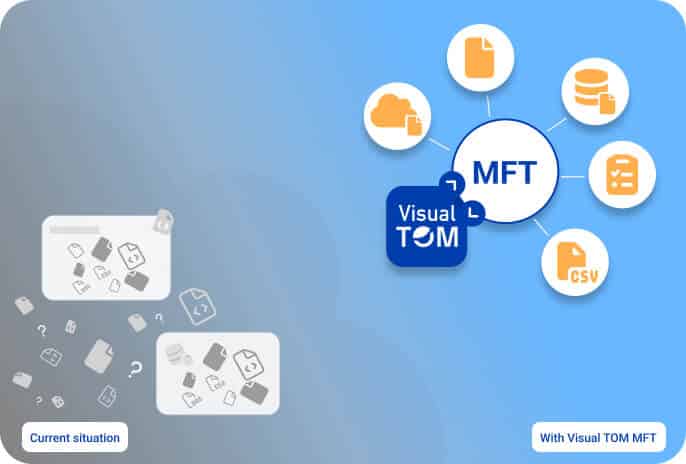
Companies are faced with a growing number of heterogeneous files from different business departments: HR, procurement, management, accounting, etc., and a mosaic of scripts, tools, and gateways that are difficult to master.
This leads to critical processes that depend on exchanges that are difficult to monitor, incidents that are hard to diagnose, risks of non-compliance, and a significant workload associated with maintaining technical complexity, without creating value.

Visual TOM MFT, the dedicated solution to simplify your exchanges
Visual TOM MFT centralizes all your file processing and transfers in a single cockpit.
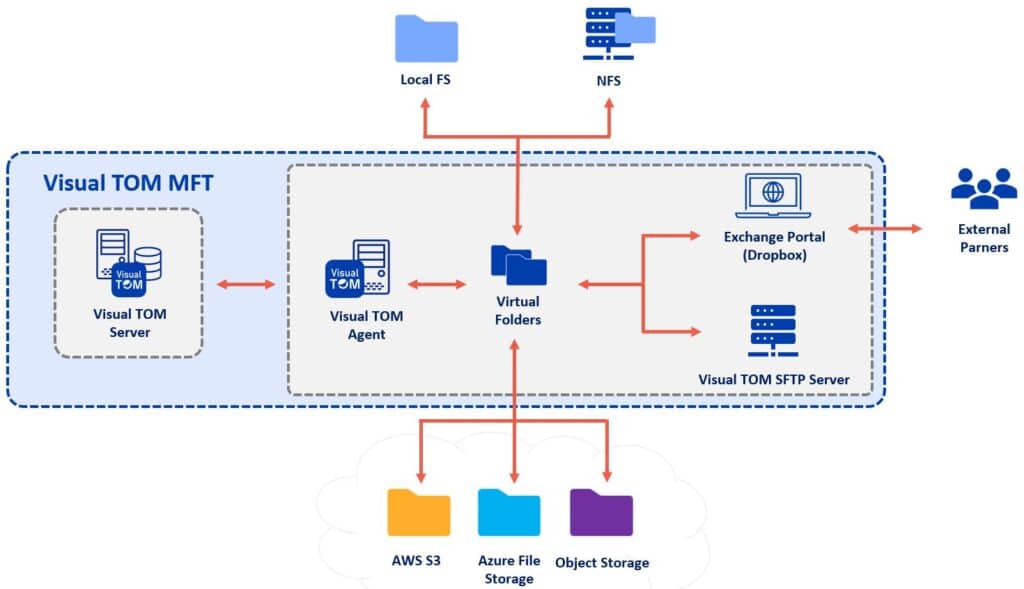
On-premises and cloud storage are unified in virtual directories, and exchanges with partners are simplified via a secure web portal.
Visual TOM MFT integrates natively with the Visual TOM automation and orchestration platform and provides a unified view of your business processes, processing chains, and file flows in hybrid environments.


The benefits of Visual TOM MFT
01
Unified cockpit to manage your processes and file transfers
02
Smart virtual folders: all your workflows can be stored in a logical location, separate from physical storage
03
Integrated security and traceability: Secure web portal for external partners, under IT control, unified authentication, access control, etc.
04
Managed TCO: fewer admin tools, fewer scripts and incidents, better quality of service
Migrate to Visual TOM MFT
Turn your historical file transfer solution into a real performance driver and replace your existing solution with Visual TOM MFT.
By consolidating your transfer workflows and processing within a single tool, you simplify operations, reduce specific developments, and gain operational efficiency, while improving your ROI.
The result: less complexity, greater reliability, enhanced governance, and a solution ready to support your business challenges.
How does Visual TOM MFT operate?
The managed file transfer platform at the center of Visual TOM
- Centralized orchestration of file transfers such as Visual TOM jobs: trigger chains when files are delivered, make a business step conditional on the safe delivery of a partner flow, chain processes and exchanges without specific scripts
- Centralization and monitoring of all your transfers: view the status of transfers in real time and log operations to facilitate diagnostics and audits
- Web portal: provide secure exchange spaces for subsidiaries, partners, subcontractors…
- Unique virtual file space: simply connect all your environments.
Access S3, Azure, FTP/SFTP, FTPS, NAS, NFS, SMB, SharePoint, Google Drive/Cloud Storage, and more - Enhanced security: Integration with corporate IT security systems (SSO/LDAP, access management, MFT operation logging…)
The MFT Offer
Visual TOM MFT is composed of three modules.
Each module is accessible separately and works with the others
- MFT Client: Integrated file transfer client, included with Performance and Ultimate editions, optional for Starter.
- MFT Gateway: Gateway for advanced transfers (remote-to-remote transfer) and integrated secure server (SFTP), deployed along with Visual TOM agents.
- MFT Portal: Secure web portal for file exchange, Dropbox alike for enterprise, with user access control for internal departments and external partners.

All you want to know about Visual TOM MFT
What is Visual TOM MFT?
Is Visual TOM MFT an alternative to GoAnywhere, Axway CFT / Secure Gateway and Sterling?
Yes. Visual TOM MFT is a French, sovereign alternative to the leading American MFT solutions such as CFT / Secure Gateway (Axway), Sterling (IBM), GoAnywhere MFT (Fortra), MOVEit (Progress Software)…
Visual TOM MFT offers:
- Complete data ownership: no file flows transit through servers outside your control
- Responsive French-speaking support based in France, with no international ticketing or intercontinental response delays
- Native integration with Visual TOM, absent from American solutions that require costly third-party connectors
- Simple, transparent pricing with no hidden costs (no limits on volume and/or number of transfers)
What is the difference between classic FTP and an MFT solution?
A classic FTP or SFTP is a basic file transfer protocol with no governance, no centralised traceability and no advanced error handling. An MFT solution like Visual TOM MFT provides:
- A unified cockpit to monitor all flows in real time across multiple transfer servers (Gateways)
- Virtual folders decoupled from physical storage (S3, Azure, FTP, NAS, SharePoint, Google Drive…)
- Complete traceability for audits and compliance
- A secure web portal for exchanges with third parties (partners, subcontractors, subsidiaries)
- Fine-grained access management: SSO, LDAP, granular permissions
- Elimination of in-house transfer scripts for flow automation
Do I need to abandon existing FTP tools to switch to Visual TOM MFT?
No. Visual TOM MFT can coexist with existing tools in the first instance.
It supports connections to existing FTP/SFTP servers and can gradually replace them at your own pace. This non-disruptive approach reduces migration risks and allows you to show results quickly without rebuilding everything from scratch.
What concrete problems does Visual TOM MFT solve?
Visual TOM MFT is particularly effective at resolving common operational issues:
- Proliferation of in-house FTP scripts that are impossible to maintain and lack supervision
- Lack of traceability for exchanges (inability to prove that a file was actually delivered)
- Manual dependencies: an operator must verify that a file has arrived before launching a process
- Unsecured partner access: sending sensitive files by email or via uncontrolled spaces
- Storage silos: each department manages its own shares without a cross-cutting view
How do virtual folders work in Visual TOM MFT?
Virtual folders are a key concept in Visual TOM MFT: they provide a unified logical view of files, regardless of their actual physical location.
A virtual folder can point to an S3 bucket, an SFTP directory, a NAS share, a SharePoint space or a Google Drive — without users or processes needing to know the underlying infrastructure. This radically simplifies flow management in hybrid or multi-cloud environments.
Is Visual TOM MFT compatible with cloud and hybrid environments?
Yes, this is precisely one of its strengths. Visual TOM MFT makes it possible to consolidate hybrid storage (on-premise + cloud) into a single view through virtual folders. It natively supports the main public clouds (AWS S3, Azure Blob Storage, Google Cloud Storage, Scaleway Object Storage, OVH, Alibaba Object Storage Service…) and can operate in complex multi-cloud or hybrid architectures.
Can Visual TOM MFT automatically trigger processes after a transfer?
Yes, and this is one of the key strengths of the integration with Visual TOM.
When a file is deposited in a monitored folder, Visual TOM MFT can automatically trigger an orchestration workflow: file processing, transformation, database loading, team notification… This end-to-end automation eliminates manual intermediate steps and complex scripts, and reduces processing times.
In which sectors is Visual TOM MFT deployed?
Visual TOM MFT meets the needs of organisations with critical file flows:
- Banking & Insurance: exchanges with the Banque de France, SEPA files, prudential reporting
- Industry: EDI flows with suppliers, order and invoicing files
- Retail & Distribution: integration of logistics flows, exchanges with e-commerce platforms
- Healthcare: transfer of medical data between institutions and information systems
- Public sector: dematerialised exchanges with government bodies and local authorities
What protocols and storage systems are supported?
Visual TOM MFT supports a wide range of protocols and storage systems:
- Transfer protocols: FTP, SFTP, FTPS
- Cloud storage: Amazon S3, Microsoft Azure Blob Storage, Google Cloud Storage, Scaleway Object Storage, Alibaba Object Storage Service…
- Network storage: NAS, NFS, SMB (Windows shares)
- Collaboration: SharePoint, Google Drive
- Secure SFTP server: hosted by Visual TOM MFT Gateway for incoming partner transfers
Does Visual TOM MFT support the PESIT and AS2 protocols?
MFT already offers a variety of secure protocols (SFTP, HTTPS, S3…). To further extend its scope, support for the PESIT and AS2 protocols is currently being implemented and will be available later in the year.
What is the MFT web portal and who is it for?
The MFT web portal is a secure exchange space accessible from a browser, with no client software installation required. It allows external partners, subsidiaries, subcontractors or customers to upload and download files independently, with configurable access rights. The IT team retains full control over spaces, users and permissions, without having to manage VPN access or individual SFTP accounts.
How does Visual TOM MFT ensure the security of exchanges?
Security is at the heart of Visual TOM MFT, with several levels of protection:
- Centralised authentication via SSO and LDAP (integration with the corporate directory)
- Granular permissions per user, group and virtual folder
- Encrypted transfers via SFTP, FTPS and HTTPS
- Complete audit trail: all operations (upload, download, deletion) are timestamped and traceable
- Role-based access control to limit exposure of sensitive data
What is the return on investment of an MFT solution?
The gains are measurable across several dimensions:
- Reduction in incidents related to failed or undetected transfers
- Time savings: no more scripts to maintain or late-night debugging thanks to centralised management
- Simplified compliance: audits are facilitated by complete, centralised traceability
- Faster go-live: new flows are configured in minutes via the graphical interface, instead of days of development
- Reduced risk of data leakage by eliminating uncontrolled exchanges (emails, WeTransfer, Dropbox, Google Drive, etc.)
- Reduced licence costs through a simple and effective commercial model